From the following article (in French) on LePoint.fr
http://www.lepoint.fr/voyages/l-hydroptere-le-bateau-qui-voulait-voler-24-08-2014-1856147_44.php
The rough Google translate is below:
By Alice Myhre
They dreamed, they did! In 1963, the publication of The 40-knot sailboat Bernard Smith, navigate 72 km / h is science fiction. Forty-five years later, in 2008, the team of Alain Thebault shouts of joy when the Hydrofoil, flying over the waves, breaking the "wall of wind": 50 knots under sail (92.6 km / h)!
In Greek hydros means "water," ptère, "wing". You understand that this is a device that combines aerospace and marine engineering. "We're like weightless, 5 or 6 feet above the water: it was like being on a magic carpet," says Alain Thebault. The secret? The foils, kinds of shaped wings that move in the water. Thanks to them, the boats take off, only connected to the sea by three foils. Supported by these submerged wings, boats double their speed in the blink of an eye. While afloat, the speed of a sailboat is limited by its length, when it was drawn up on the foils, the water is no longer an obstacle but a fulcrum. Thus, Hydrofoil, with only 2.5 m2 in contact with the water, sailing at 30 knots with a wind of 15! It's wanting to overcome the laws of physics that some enthusiasts have devised this system. But it took a hundred years of research before coming to near perfection: the Hydrofoil Alain Thebault.
Suspended in the air
In 1861, wanting to test wings planned for the first aircraft, the British Thomas Moy discovered the principle of the hydrofoil. The idea, once launched, will spread gradually. Sailboats to powerboats, experiments are linked to the United States and Europe. Many engineers are interested, including big names such as Alexander Graham Bell. The latter, after having equipped with foils motorboats, Nancy realizes, a model sailboat equipped with this wing. We are in 1912 and eight years later, the first patent was filed by Malcolm Thomas McIntyre and brothers. Their boat he sailed really? It
remains a mystery.
Testing, from 1938, models in her bathtub, Robert Gilruth initiate a turn. In the living room of his apartment, the future director of NASA goes from scratch to develop the first hydrofoil on water: Catafoil. In 1941, in the Chesapeake Bay on the East Coast of the United States, this boat has a great foil in "v" takes off. "It was a great time, we sailed low in the water at about 4 knots trying to catch a sailboat ... After having passed, we got up on the foils. You can imagine their shocked looks when we went to about 12 knots, hanging in the air, "tell the pioneer.
Then, in the 1950s, Gordon Baker, technology enthusiast, dreams of designing a hydrofoil sailboat marketable. This project, funded by the Navy, gave birth to the Monitor. After seventeen years of research, Baker finally pilot his car, whose stability is surprising. Hands on a car steering wheel, it reaches 35 knots, a record that will not be beaten 35 years later! Paradoxically, this engineering gem can not find opportunities. Well, not quite. Ten years later, the American David Keiper, he still believes. He dreams of a foiling trimaran can take off. He designs the Williwaw. The boat, equipped with retractable foils, travels the oceans. It carries 20,000 nautical miles, solo or in teams. Even if it is not built for speed records, the hydrofoil is propelled into the era of sailing the high seas.
"We're going to be scared"
Meanwhile, Eric Tabarly, driven by instinct, think the future of racing through the multihulls. Aboard his giant trimaran Pen Duick IV, lighter, less sail and easier to maneuver solo skipper search pure speed. In 1968 he crossed the Atlantic in 10 days and 11 hours, smashing all records! A year later, he discovered for the first time a hydrofoil: the Williwaw. This face-to-face give him wings to embark on a new project: the construction of the Paul Ricard which transposes the foils on an "offshore racing machine."
The initial objective of improving the stability and drift boat is quickly exceeded. Engineers, especially Pierre Perrier, revved "They began their study, following the idea that I had given them, but less shy than me, they arrived quickly to take off the boat for them c. really was the way forward, "explained Tabarly. Based on a hull Tornado, they build a prototype in 1976 whose essays are dreaming. Unfortunately, the materials of the time did not allow to build the full-scale machine. Tabarly was stuck with the Paul Ricard, a pale copy that can take off only partially. Shortly afterwards, Alain Thebault intervenes. He contacted Tabarly, takes the original project and began building what would become Hydrofoil.
Between the first model produced in 1985 and the first record broken by hydrofoil in 2005, the team of Alain Thebault had to sail in troubled waters. "We flew over the area still little known high speed sailing. I think at times we will be afraid," confided at the time Alain Thebault ("The Hydrofoil, the breath of a dream" by Thalassa). Indeed, the challenge is to marry the lightness and strength of the boat. The foils must be particularly robust to withstand stronger than that experienced by the wings of fighter planes pressure twice. In addition, when the node 50 reaches Hydrofoil, water boils around airfoils, thus reducing the stability of the vessel, among others. A year after their first flight, floats breaks during an event at sea. "It [was] glad I brought the boat. This was not granted," recalls Alain Thebault. After several failed attempts, they finally manage to beat their first record.
The instinct of the Marine is not enough
It was in 2005 that the Hydrofoil IV gained a few precious seconds on 35 minutes set by the aviator Louis Bleriot between Dover and Calais. Then addressing the world speed records, the creature becomes the world's fastest boat. In 2008, breaking through the 100 km / h, the team will pay his madness a spectacular dismasted. "We really had the wind barrier This is quite extraordinary in terms of skiing and feel very airline. It ended badly, but hey, is cleared as pioneers. " But with a top speed of 56 knots (104 km / h), their pole position was thrilled later by Australian Paul Larsen aboard his Vestas SailRocket.
At such a speed, instinct alone is not enough. The crew of the Hydrofoil is assisted by an arsenal of electronic devices that measure every reaction of the boat. The democratization of this type of machine is not for now, even with the marketing of smaller models, such as the Flying Phantom One of Martin Fischer. After a hundred years of research, performance competition continues. The engineers of the future will win new challenges. , We await the day when the Hydrofoil will tour the world above the waves.
Showing posts with label Alain Thebault. Show all posts
Showing posts with label Alain Thebault. Show all posts
Monday, 25 August 2014

Wednesday, 24 April 2013
L'Hydroptere detail photos of onboard equipment
This gallery of photos comes courtesy of Chris Ostlind who was invited aboard to have a look over L'Hydroptere and shot some of the more obscure parts of the boat which we rarely get to see. It's interesting to observe the aircraft like construction of the structure. This fully foiling craft has been constantly modified, updated and improved. Currently on the hard and receiving attention in preparation for the LA to Honolulu Transpac attempt
http://imgur.com/a/8pbcf
http://imgur.com/a/8pbcf
 |
| L'Hydroptere, photo courtesy Chris Ostlind |
Sunday, 20 January 2013
Daily Sail article on the L'Hydroptere teams future ambitions
Interesting article on the Daily Sail, Alain Thebault and the L'Hydroptere Team are looking to build a new craft to challenge the new record set by Paul Larsen on Sailrocket. Also still looking for funding for their new maxi Hydroptere. Thanks to Doug Lord for the link:
http://www.thedailysail.com/offshore/13/63761/0/the-future-of-lhydroptere
After an eventful year in the USA, Alain Thébault's L'Hydroptere team of is taking advantage of the winter to fine-tune their technological and sports program as they continue their search to find a new sponsor, following the premature departure of DCNS last autumn.
Before the Christmas holidays, L'Hydroptere was laid up in the bay of San Francisco as her team works on a five year development program for their radical boat.
read more here
http://www.thedailysail.com/offshore/13/63761/0/the-future-of-lhydroptere
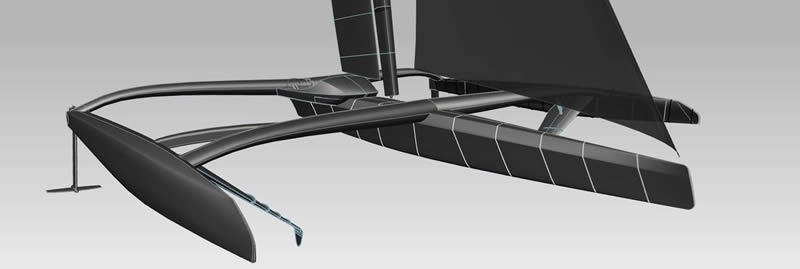
Before the Christmas holidays, L'Hydroptere was laid up in the bay of San Francisco as her team works on a five year development program for their radical boat.
read more here
Sunday, 18 November 2012
Hydroptere team receive additional sponsorship from Lanson Champagne
After the loss of their major sponsor DCNS the Hydroptere team have been seeking to recruit new partners for sponsorship to allow them to resume their Ocean record programme. Lanson Champagne have stepped up their involvement.
Article from bymnews.com
http://www.bymnews.com/news/newsDetails.php?id=111902
LANSON champagne strengthen its partnership with Hydroptère
Article from bymnews.com
http://www.bymnews.com/news/newsDetails.php?id=111902
LANSON champagne strengthen its partnership with Hydroptère
Saturday, 17 November 2012
As a partner of Alain Thébault since 2008, the Champagne house LANSON has decided to strengthen its partnership with the Hydroptère project by becoming "official partner of Hydroptère."
The United States represent a new challenge for LANSON and they wished to increase their support to the project in order to accompany the team in their Pacific record attempt next summer, departing from Los Angeles. This announcement was warmly greeted by the entire crew.
"We are entering a period of transition. With the strengthened support of LANSON, a new chapter begins. This will help maintain an operational team in San Francisco in the short term, which is very important. I thank LANSON for their faithfulness and confidence. The French luxury joins the adventure with style," said Alain Thébault, designer and skipper of Hydroptère.
more here
Subscribe to:
Posts (Atom)